
Knowing what is total revenue and how to calculate total revenue sounds simple, but many business owners still confuse total revenue with net revenue or net income. Total revenue shows the full sales power of a business before deductions, returns, or expenses. If you want to understand your top line, you need the right total revenue formula, a clear revenue equation, and a practical way to apply it across different business models.
Interactive Tool: The Total Revenue Calculator
Total Revenue by Business Model Calculator
Use this calculator to estimate total revenue for different business models. Product businesses use units sold and price per unit. Service businesses use billable hours and hourly rate. Subscription or SaaS businesses use active subscribers and monthly subscription fee.
Product Business
Service Business
Subscription or SaaS Business
Product Business Revenue = Units Sold × Price Per Unit
Service Business Revenue = Billable Hours × Hourly Rate
Monthly Subscription Revenue = Active Subscribers × Monthly Subscription Fee
Annualized Subscription Revenue = Monthly Subscription Revenue × 12
A total revenue calculator helps you quickly test price and volume changes. Enter your selling price and quantity sold, and the tool shows your total revenue instantly. For example, if you sell 300 products at $45 each, your total revenue is $13,500. If you lower the price to $40, you would need to sell 338 units to slightly beat that same revenue target. This makes the calculator useful for pricing, promotions, and sales forecasting.
How To Calculate Total Revenue By Business Model
The basic revenue equation changes slightly depending on what you sell. A product business usually uses units sold multiplied by price per unit.
Product Business:
Total Revenue = Units Sold × Price Per Unit
If you sell 200 purses at $50 each, total revenue is $10,000.
A service business uses billable hours multiplied by hourly rate.
Service Business:
Total Revenue = Billable Hours × Hourly Rate
If a consultant bills 80 hours at $120 per hour, total revenue is $9,600.
A subscription or SaaS business calculates monthly revenue from active subscribers.
Subscription Business:
Monthly Revenue = Active Subscribers × Monthly Subscription Fee
If you have 500 active subscribers paying $30 per month, monthly total revenue is $15,000. Annualized, that becomes $180,000 before churn, upgrades, refunds, or discounts.
Total Revenue Vs. Net Revenue Vs. Net Income

Total revenue, net revenue, and net income are not the same. Mixing them up can lead to bad pricing decisions and misleading reports. Total revenue, or gross revenue, is all money generated from sales before customer deductions. It answers: how much did we sell?
Net revenue is total revenue minus refunds, customer returns, discounts, and allowances. It answers: how much sales revenue remains after customer-level deductions?
Net income is final profit after all operating expenses are deducted. That includes rent, payroll, marketing, software, taxes, interest, and other business costs. It answers: how much money did the business actually keep? For example, if a store has $100,000 in total revenue, $8,000 in returns, and $2,000 in discounts, net revenue is $90,000. If operating expenses are $70,000, net income is $20,000.
How To Calculate Total Revenue In Excel
Calculating total revenue in Excel is straightforward when your data is organized clearly.
If you already have a revenue column, use:
=SUM(B2:B10)
This works when cells B2 through B10 already contain revenue totals for each product, invoice, or sales channel.
If you have separate price and quantity columns, use:
=SUMPRODUCT(B2:B10,C2:C10)
This multiplies each price by its matching quantity, then adds all results together. It is faster than creating helper columns.
Example layout:
Product | Price | Quantity |
|---|---|---|
Item A | 25 | 100 |
Item B | 40 | 50 |
Item C | 15 | 200 |
The formula =SUMPRODUCT(B2:B4,C2:C4) calculates total revenue across all products in one step. This is the cleanest total revenue formula in Excel for a raw sales table.
Beyond The Math: Why Total Revenue Matters

Total revenue matters because it shows business activity, demand, and sales capacity. It helps owners forecast growth, evaluate pricing strategies, and understand whether sales channels are working. It also helps answer pricing questions. If you lower your price, how many more units do you need to sell to reach the same revenue goal? If you raise your price, how many customers can you lose before revenue falls?
Total revenue is also useful for comparing months, quarters, and years. Growing total revenue may show stronger market demand. But if net revenue or net income is falling, the business may have discounting, return, cost, or leakage problems. That is why total revenue should be tracked alongside net revenue, gross margin, cash flow, and profit.
Common Mistakes When Calculating Total Revenue
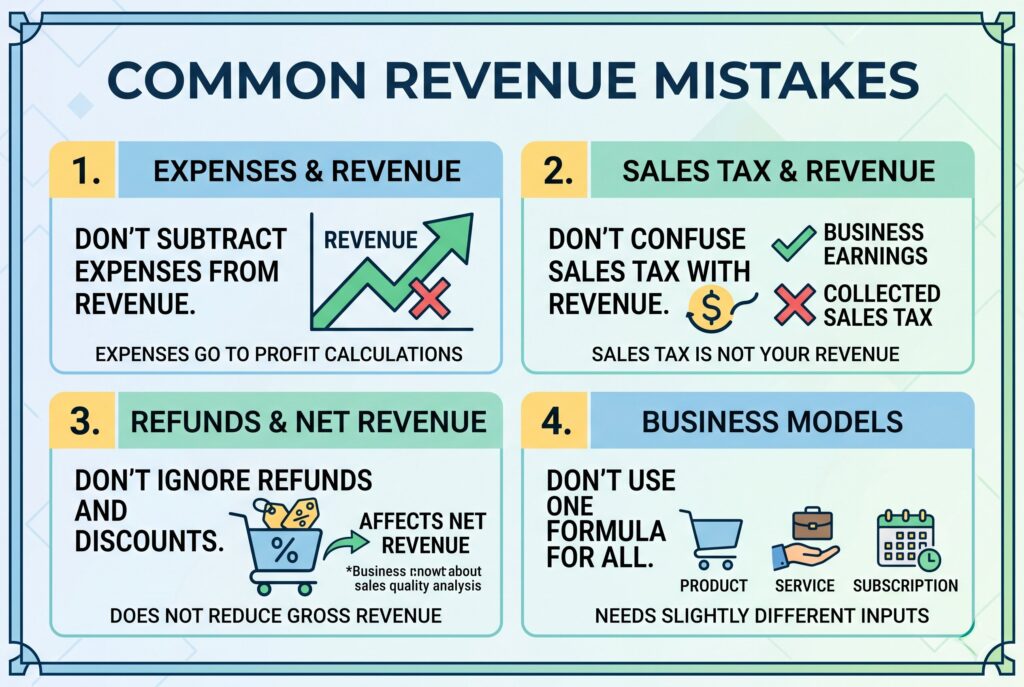
Don’t subtract expenses from total revenue. Expenses belong to profit calculations, not total revenue. Don’t confuse sales tax with revenue. If you collect sales tax on behalf of the government, it usually isn’t revenue your business earned.
Don’t ignore refunds and discounts when analyzing sales quality. They don’t reduce total revenue in the strict gross sense, but they do affect net revenue. Don’t use one formula for every business without thinking. Product, service, and subscription models all need slightly different inputs.
Conclusion
Total revenue is your top-line sales number. It shows how much money your business generated before deductions and expenses. The formula is simple, but the interpretation matters. Use the total revenue formula to measure sales activity, then compare it with net revenue and net income to understand whether sales are turning into real profit. Smart business owners won’t just chase bigger revenue. They’ll track the full path from top line to bottom line.