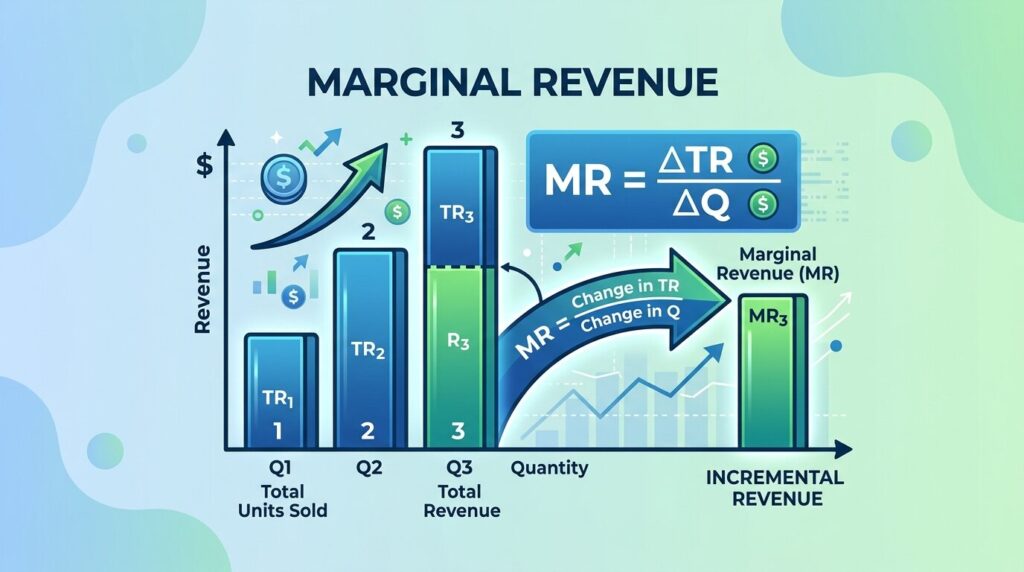
What is the best definition of marginal revenue? Marginal revenue is the additional income a business earns from selling exactly one more unit of a product or service. While the term may sound like dry economics language, it’s one of the most practical tools for pricing, discounting, and profit planning. If a company understands what is marginal revenue, it can answer a critical question: “Is this next sale actually helping the business, or are we giving away profit to chase volume?”
How to Calculate Marginal Revenue
The formula for marginal revenue is:
To calculate it, follow three steps.
- Step 1: Calculate your change in total revenue.
Subtract the old total revenue from the new total revenue. - Step 2: Calculate your change in quantity.
Subtract the old number of units sold from the new number of units sold. - Step 3: Divide the change in total revenue by the change in quantity.
Example: A business sells 100 units and earns $10,000. After changing its price, it sells 110 units and earns $10,800.
Change in total revenue = $10,800 – $10,000 = $800
Change in quantity = 110 – 100 = 10
Marginal revenue = $800 / 10 = $80
That means each additional unit added $80 in revenue.
Interactive Tool: The Marginal Revenue & Profit Maximizer
A useful marginal revenue tool should compare price, quantity, total revenue, marginal cost, and profit impact. Here’s a simple version you can use manually:
- Current revenue: Price × Current units
- New revenue: New price × New units
- Marginal revenue: Change in revenue / Extra units sold
- Profit test: Compare marginal revenue with marginal cost
For example, suppose your product sells for $120 and your marginal cost is $65. If a discount increases sales but drops marginal revenue to $50, the extra sales aren’t profitable. If marginal revenue stays at $85, the extra sales still create profit. This is where marginal revenue becomes a real business decision tool, not just a formula.
Marginal Revenue & Profit Maximizer
Marginal Revenue in Theory vs. Real-World Practice

In economics class, marginal revenue often assumes that to sell one more unit, a company must lower the price for all units sold. That means one extra sale can reduce revenue from earlier units, which may cause marginal revenue to fall quickly.
In the real world, businesses usually have more flexibility. They use tiered pricing, customer-specific discounts, bundles, volume discounts, seasonal offers, and segmented pricing. A company might sell 10 units at full price and discount only the 11th unit for a specific buyer. That means real-world marginal revenue may behave differently from the textbook model. The key is to calculate based on actual total revenue, not just the sticker price of the next unit.
The Golden Rule: Marginal Revenue vs. Marginal Cost

Marginal revenue only becomes powerful when compared with marginal cost. Marginal cost is the extra cost of producing or delivering one more unit. This may include materials, labor, payment processing, shipping, support time, or platform costs.
- If MR > MC, selling more is profitable.
- If MR < MC, each extra sale loses money.
- If MR = MC, the business is at the profit-maximizing point.
This MR = MC rule is the golden rule of profit maximization. It doesn’t mean the company should stop growing forever. It means that under current pricing and cost conditions, producing beyond that point may reduce profit. For example, if marginal revenue is $90 and marginal cost is $60, the business earns $30 of contribution from the next unit. But if discounts push marginal revenue down to $45 while marginal cost remains $60, more sales can actually hurt the bottom line.
Why Marginal Revenue Can Go Negative
Marginal revenue can become negative when total revenue falls after selling more units. This usually happens when a company cuts prices so aggressively that the extra units sold don’t make up for the lower price. This is tied to demand elasticity. If demand is elastic, a price cut may increase total revenue because customers respond strongly. If demand is inelastic, a price cut may fail to attract enough new buyers, causing total revenue to drop. For example, if you sell 100 units at $100, total revenue is $10,000. If you drop the price to $90 and sell 105 units, total revenue becomes $9,450. You sold more, but total revenue fell. In that case, marginal revenue is negative. This is the trap: more sales don’t always mean more money.
Common Calculation Pitfalls to Avoid
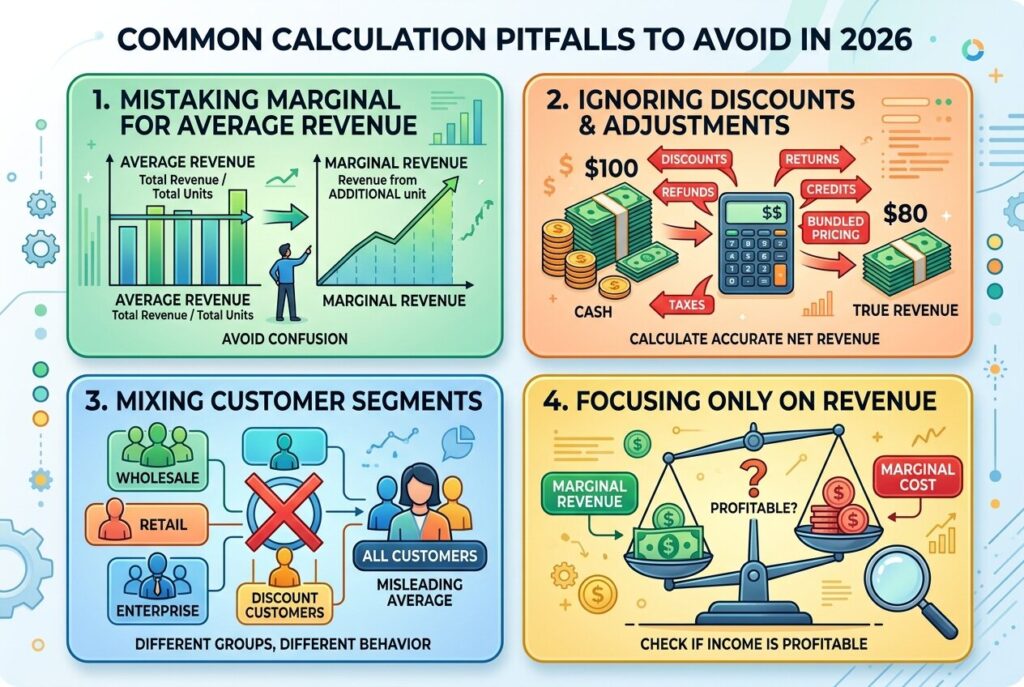
The first mistake is confusing marginal revenue with average revenue. Average revenue is total revenue divided by total units sold. Marginal revenue only measures the revenue from the additional unit or batch of units. The second mistake is ignoring discounts, refunds, taxes, returns, credits, and bundled pricing. If a customer pays $100 but you issue a $20 credit, your true revenue from that sale isn’t $100.
The third mistake is mixing segments. Don’t calculate marginal revenue across wholesale, retail, enterprise, and discount customers as if they behave the same way. Different customer groups may have different price sensitivity. The fourth mistake is using revenue without checking marginal cost. Marginal revenue alone tells you about extra income. It doesn’t tell you whether that income is profitable.
Expanding the Concept: Marginal Revenue Product
Marginal revenue focuses on selling goods or services. Marginal revenue product applies the same idea to resources, especially labor. Marginal revenue product measures the additional revenue generated by adding one more unit of input, such as hiring one more worker, adding one more salesperson, or increasing machine hours.
This connects to marginal product and marginal product of labor. Marginal product measures the additional output created by one more input. Marginal product of labor measures the extra output from hiring one more worker. Marginal revenue product converts that extra output into revenue. For example, if hiring one additional salesperson generates $12,000 in extra monthly revenue and their monthly cost is $7,000, the hire may be financially justified. But if the extra revenue is only $5,000, the company may need to rethink the role, territory, quota, or compensation plan.
Conclusion
Marginal revenue is a simple concept with major business value. It helps companies see whether the next sale, next discount, next production run, or next hire is truly profitable. The main lesson is this: more sales don’t automatically mean more profit. By tracking marginal revenue alongside marginal cost, businesses can price more intelligently, discount more carefully, and scale without bleeding cash. In 2026, the companies that understand marginal revenue won’t just chase growth. They’ll chase profitable growth.