



If you’re looking for a way to diversify your investment portfolio and potentially earn higher returns, hedge funds might be an option to explore. These investment vehicles are often associated with higher risk, but they also offer the potential for significant rewards. Whether you’re a seasoned investor or just getting started, understanding how hedge funds work, the strategies they employ, and why they may be worth considering is crucial for making informed financial decisions.
In this article, we’ll break down what hedge funds are, how they work, the different strategies they use, and why they might be a good fit for certain investors. By the end, you’ll have a clearer picture of what hedge funds can offer and whether they’re a smart investment choice for your portfolio.
What Is a Hedge Fund?
A hedge fund is an actively managed investment fund that pools capital from accredited investors and employs various strategies to achieve high returns. Unlike mutual funds, which typically invest in stocks, bonds, and other traditional assets, hedge funds have greater flexibility and can invest in a wider array of assets, including derivatives, commodities, and real estate.
The primary goal of a hedge fund is to maximize returns while minimizing risk. Hedge fund managers often use leverage (borrowed money) and other advanced strategies to outperform the market. This makes hedge funds a popular choice for high-net-worth individuals and institutional investors looking for higher returns than what is typically offered by traditional investment vehicles.
How Do Hedge Funds Work?

Hedge funds operate by pooling money from accredited investors (individuals or institutions that meet specific financial criteria). The fund manager then uses the pooled capital to invest in a variety of assets, seeking to generate profits while protecting against downside risk.
Key Features of Hedge Funds
- Active management: Hedge fund managers actively manage the fund by making strategic investments and frequently adjusting positions to capitalize on market opportunities.
- Leverage: Hedge funds often use leverage to amplify returns. By borrowing money, hedge funds can increase the size of their investments, but this also increases the potential for loss.
- Short selling: In addition to buying assets, hedge funds also engage in short selling, where they borrow shares of a stock and sell them with the expectation that the stock price will fall, allowing them to buy it back at a lower price and make a profit.
- Hedging: As the name suggests, hedge funds employ hedging strategies to reduce risk. This could include taking opposite positions in correlated assets to offset potential losses.
While hedge funds are often associated with higher risk, they also aim for higher rewards by using these sophisticated strategies.
Types of Hedge Funds
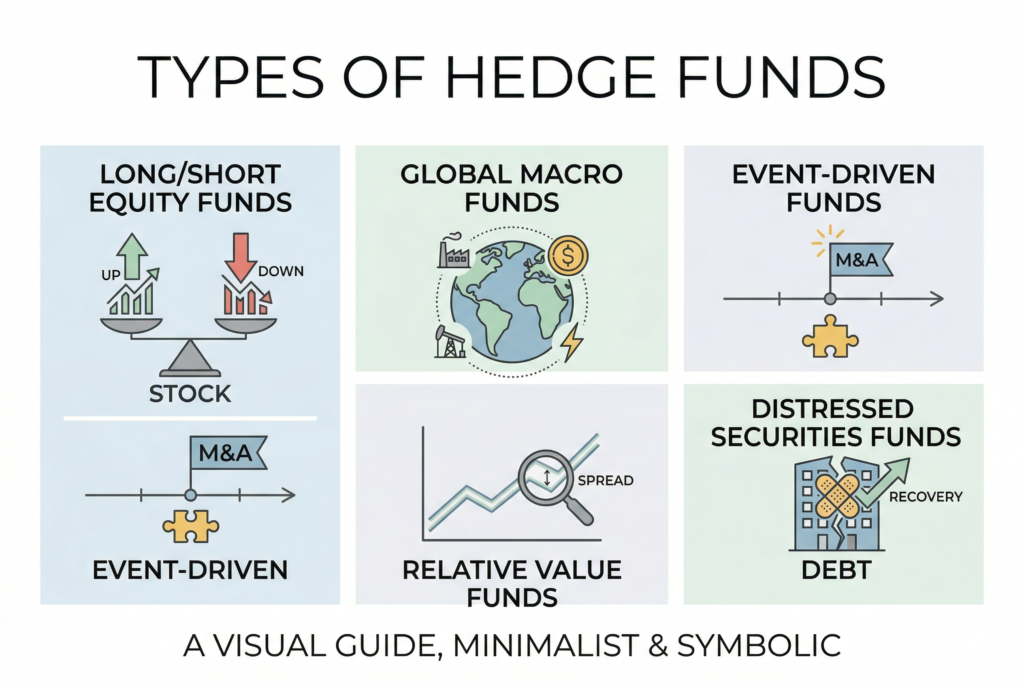
Long/Short Equity Funds
These funds take long positions in stocks that the manager expects to rise in value and short positions in stocks they believe will decline. This long/short strategy allows the fund to potentially profit from both rising and falling markets.
Global Macro Funds
Global macro funds base their investment decisions on macroeconomic trends such as interest rates, inflation, and currency fluctuations. They may invest in a variety of assets, including commodities, currencies, and stocks, depending on the economic outlook.
Event-Driven Funds
Event-driven hedge funds focus on corporate events, such as mergers, acquisitions, bankruptcies, or spinoffs, which may create opportunities for profit. These funds aim to capitalize on the market’s reaction to these events, often buying or shorting stocks in anticipation of a change in value.
Relative Value Funds
Relative value hedge funds seek to exploit price discrepancies between related assets. For example, they might take positions in two similar stocks or bonds, betting that the price difference between the two will converge. These funds generally aim to make profits without taking on directional market risk.
Distressed Securities Funds
These hedge funds invest in distressed assets, such as the bonds or stocks of companies facing financial trouble. The idea is that the company’s situation is temporary, and the assets will recover, offering significant returns. These funds are typically higher risk but can also be highly profitable when they succeed.
Hedge Fund Strategies: How They Maximize Returns

1. Leverage
Leverage involves using borrowed money to increase the size of an investment. Hedge funds use leverage to amplify potential returns, but it also increases the risk. While leverage can lead to higher profits, it can also magnify losses if the market moves against the fund’s positions.
2. Arbitrage
Arbitrage involves taking advantage of price differences between markets or related assets. For example, a hedge fund might buy an asset in one market where it is undervalued and sell it in another market where it is overvalued, pocketing the difference. This strategy requires precise execution and a deep understanding of market inefficiencies.
3. Short Selling
Short selling is a strategy where the hedge fund borrows shares of a stock and sells them with the expectation that the stock price will fall. If the stock price declines, the hedge fund can buy back the shares at a lower price, returning them to the lender and profiting from the difference.
4. Risk Arbitrage
Risk arbitrage is a strategy often used in event-driven hedge funds. It involves betting on the successful completion of a corporate event, such as a merger or acquisition. For example, a hedge fund might buy stock in a company being acquired and short the stock of the acquiring company, hoping for a smooth transaction and profit from the price differences.
Why Hedge Funds Are Worth Considering

Diversification
Hedge funds can offer a level of diversification that traditional investments don’t. By using alternative investment strategies such as short selling, leverage, and arbitrage, hedge funds may be able to generate returns regardless of the overall direction of the market, providing stability during volatile times.
Potential for High Returns
Hedge funds often target high returns by taking on more risk and using advanced strategies. For sophisticated investors who are willing to take on some risk for potentially higher gains, hedge funds offer a chance to outperform traditional investments.
Professional Management
Hedge funds are actively managed by professionals with expertise in the market. These managers use advanced strategies, algorithms, and extensive research to make informed investment decisions. Investors benefit from the experience and insight of top-tier fund managers who are dedicated to maximizing returns.
Access to Alternative Investments
Hedge funds allow investors to gain access to alternative investment vehicles such as commodities, distressed assets, and global macro strategies, which aren’t available through traditional investment vehicles like mutual funds or exchange-traded funds (ETFs).
How to Invest in Hedge Funds
Investing in hedge funds typically requires meeting specific criteria, such as being an accredited investor or having a high net worth. Hedge funds usually have high minimum investment requirements, often in the range of $100,000 to $1 million, and they may also come with high fees, including the “2 and 20” model (a 2% management fee and 20% of the profits).
However, there are ways for individual investors to gain exposure to hedge fund strategies without investing directly in hedge funds. For example, hedge fund ETFs and mutual funds allow retail investors to access similar strategies at a lower cost and with more liquidity.
Conclusion: Hedge Funds Can Be a Smart Investment Choice for the Right Investor
Hedge funds are a powerful investment tool that can help you diversify your portfolio, access alternative investments, and potentially earn high returns. While they are not without risk, hedge funds offer diversified strategies for sophisticated investors who are comfortable with higher risk.
Before investing in hedge funds, it’s essential to evaluate your risk tolerance, financial goals, and investment horizon. With careful research and the right strategy, hedge funds can be a valuable addition to a well-rounded portfolio.

