



The phrase no tax on overtime sounds simple, almost too good to question. But the real rule is more specific: it’s an overtime tax deduction claimed on your federal tax return, not a promise that overtime pay will disappear from every tax calculation on your weekly paycheck. For workers who regularly stay late, pick up extra shifts, or depend on overtime to stabilize household income, this deduction can still matter. Used correctly, it may reduce taxable income and increase a refund or lower a tax bill. Used carelessly, it can create confusion between wages, withholding, payroll taxes, and state taxes.
Interactive Tool: 2026 Overtime Tax Deduction Calculator
A no tax on overtime calculator should start with one key detail: not all overtime wages are necessarily deductible. Qualified overtime compensation generally means the portion that exceeds your regular rate of pay, often the “extra half” in time-and-a-half pay.
Example: if your regular rate is $20 per hour and your overtime rate is $30, only the extra $10 overtime premium may qualify. If you worked 300 overtime hours, your estimated qualified overtime amount would be $3,000.
To estimate your savings, multiply your qualified overtime deduction by your marginal federal tax rate. A $3,000 deduction at a 22% rate could reduce federal income tax by about $660. That isn’t a guaranteed refund, but it’s a useful planning estimate.
When Does “No Tax on Overtime” Start?
The answer to no tax on overtime when does it start depends on whether you mean earning the money or filing the return. The deduction applies to tax years 2025 through 2028. That means overtime earned in 2025 may be claimed on a 2025 federal return filed in spring 2026.
This distinction matters because your paycheck may not suddenly look tax-free. Employers may still withhold federal income tax during the year. You may see the benefit later when filing your tax return, depending on your total income, withholding, and final qualified overtime amount.
Who Qualifies for No Tax on Overtime?

The basic answer is workers with qualified overtime pay, but eligibility has limits. The deduction is tied to overtime compensation that exceeds the worker’s regular rate of pay and is reported on Form W-2 or Form 1099.
MAGI, or Modified Adjusted Gross Income, also matters. MAGI starts with adjusted gross income and adds back certain deductions or exclusions. For this deduction, the phaseout begins above $150,000 for single filers and $300,000 for joint filers.
In plain English: higher-income taxpayers may get a reduced deduction or lose it entirely. That’s why two workers with the same overtime hours may receive very different tax outcomes.
The Truth: How the Overtime Tax Deduction Actually Works
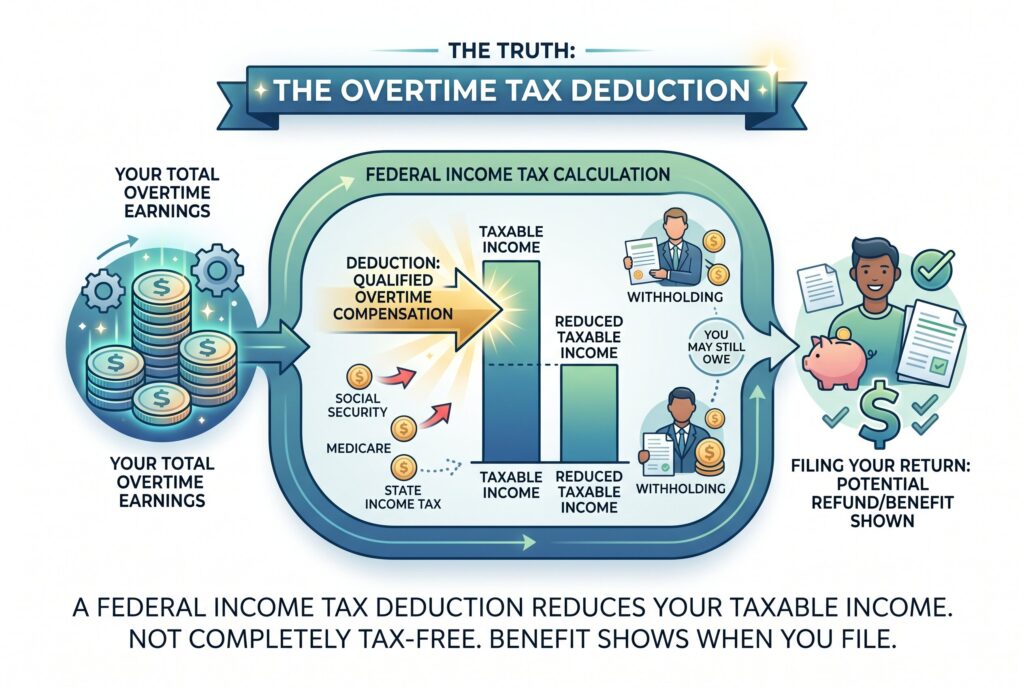
No tax on overtime explained correctly means this: it’s a federal income tax deduction. It isn’t the same as making overtime completely tax-free. You may still owe Social Security and Medicare taxes. You may still owe state income tax unless your state follows the federal rule or creates its own break. Your employer may still withhold taxes from your paycheck. And the benefit may only show up fully when you file your tax return.
This is why the phrase no tax on overtime can be misleading. A deduction reduces taxable income. A credit reduces tax directly. A payroll exemption would change withholding rules more dramatically. This provision is mainly a return-level deduction for qualified overtime compensation.
Employer W-2 Reporting: What to Look For in 2026
Workers should review year-end pay records carefully. The IRS says that if a statement doesn’t report qualified overtime compensation, taxpayers should use Schedule 1-A instructions to calculate the amount.
For 2026 filing, this creates a practical habit: save paystubs. Don’t rely only on memory or total overtime wages. You may need to separate regular pay from the overtime premium. The cleanest documentation will show regular hours, overtime hours, overtime rate, and the premium portion. If your W-2 or payroll statement lists overtime in a separate box or note, compare it against your final paystub. If it doesn’t, ask payroll whether they can provide a year-end overtime breakdown.
FAQ: Common Misconceptions About Tax-Free Overtime
- Is overtime still taxed? Yes, parts of it can still be taxed. The deduction applies to federal income tax, subject to limits, but payroll taxes may still apply.
- Does it apply to salary workers? It depends. Some salaried workers are nonexempt and receive overtime under wage-and-hour rules. Others are exempt and don’t receive qualifying overtime.
- Is the full time-and-a-half amount deductible? Usually, no. The qualified amount is generally the premium above the regular rate, not the entire overtime paycheck.
- Do I need to itemize? No. The IRS states the deduction is available whether you itemize or take the standard deduction.
Conclusion
The new overtime tax deduction can be valuable, but only if you understand what it does and doesn’t do. It doesn’t erase every tax from overtime. It doesn’t automatically make your paycheck tax-free. It does create a federal deduction for qualified overtime compensation, within income and annual limits.
Before filing, save your paystubs, check your W-2, review Schedule 1-A instructions, and consider talking with a tax professional if your overtime is substantial or your income is near the phaseout range. The workers who benefit most won’t be the ones who rely on the headline. They’ll be the ones who document the numbers carefully.

