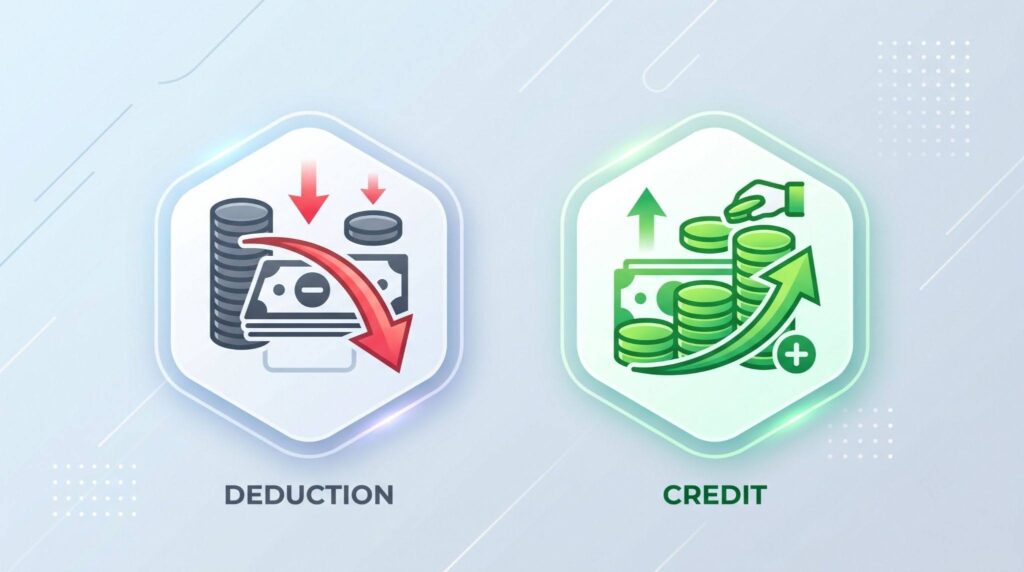
A tax deduction reduces your taxable income, while a tax credit directly reduces the amount of tax you owe. For example, a $1,000 deduction may only save you a percentage of that amount based on your tax bracket, whereas a $1,000 tax credit can lower your tax bill by the full $1,000. Because credits provide a dollar-for-dollar reduction, they are generally more valuable than deductions.
What Is a Tax Deduction?
A tax deduction reduces the amount of income the IRS can tax. Think of it as a discount coupon that lowers your taxable income before your tax bill is calculated. For example, a $1,000 deduction may only save about $220 if you’re in the 22% tax bracket because it reduces the income subject to tax rather than the tax itself.
What Is a Tax Credit?
A tax credit directly reduces the amount of tax you owe after your tax bill has been calculated. Unlike deductions, credits provide a dollar-for-dollar reduction. For example, a $1,000 tax credit can lower your final tax bill by the full $1,000, making credits one of the most valuable tax-saving tools available.
Interactive Tool: The $1,000 Credit vs. Deduction Value Estimator
$1,000 Credit vs. Deduction Value Estimator
The easiest way to compare a credit and a deduction is to run the same dollar amount through both paths. A $1,000 tax credit reduces your tax bill by $1,000. If your tax bill is $3,500, that credit can bring it down to $2,500. A $1,000 deduction works differently. It reduces taxable income, not the final bill. Your real savings depend on marginal tax rate math. The basic formula is:
Estimated tax savings = Deduction amount x Marginal tax rate
So if your marginal tax rate is 12%, a $1,000 deduction may save about $120. If your marginal rate is 24%, the same deduction may save about $240. If your marginal rate is 32%, it may save about $320. This is why a credit and deduction with the same face value don’t create the same result.
The Chronological Breakdown: How the IRS Calculates Your Bill

To understand tax credit vs tax deduction, follow the order of the tax return. First comes gross income. This includes wages, freelance income, business income, interest, dividends, and other taxable earnings. Next come deductions. This is where reducing taxable income happens. Deductions lower the income number before the IRS applies tax rates. After that, the IRS calculates your tax liability. This is the amount of tax you owe before credits. Finally, credits reduce that tax liability directly. A tax credit comes near the end of the process, which gives it strong dollar-for-dollar power.
A simple flow looks like this:
Gross income
minus deductions
equals taxable income
multiplied by tax rates
equals tax liability
minus credits
equals final tax bill or refund position
That timing is the reason credits often beat deductions in direct cash value.
Tax Deductions Explained: Lowering the Target
Tax deductions don’t hand you money directly. They shrink the target the IRS uses to calculate your tax bill. Common deductions may include retirement contributions, student loan interest, mortgage interest, charitable gifts, certain medical expenses, and eligible business costs. Some deductions are available only if you meet specific requirements. One major decision is standard vs itemized deduction. The standard deduction is a fixed amount based on filing status. You don’t need to list individual expenses to claim it.
Itemized deductions require more detail. You add up eligible expenses such as mortgage interest, state and local taxes, charitable contributions, and qualifying medical costs. Itemizing only makes sense when your total itemized deductions exceed your standard deduction. Then there are above the line deductions. These are especially useful because they can reduce adjusted gross income before you even choose between standard and itemized deductions. Examples may include certain IRA contributions, student loan interest, educator expenses, or self-employed retirement contributions.
Above the line deductions can be powerful because they may lower AGI or MAGI, which can affect eligibility for other credits and tax benefits.
| Type of Deduction | How It Works | Examples | Key Benefit |
| Standard Deduction | Fixed amount based on filing status. No need to track or list expenses. | Standard deduction for Single, Married Filing Jointly, etc. | Simple and easy to claim. |
| Itemized Deduction | Requires listing eligible expenses individually. | Mortgage interest, charitable donations, state and local taxes, medical expenses. | Can provide greater tax savings if total deductions exceed the standard deduction. |
| Above-the-Line Deduction | Reduces Adjusted Gross Income (AGI) before choosing standard or itemized deductions. | Traditional IRA contributions, student loan interest, educator expenses, self-employed retirement contributions. | May lower AGI and improve eligibility for other tax credits and benefits. |
Tax Credits Explained: Dollar-for-Dollar Power
Tax credits reduce your tax bill directly. This is the reason many taxpayers search for credits first when trying to maximize a refund.
There are three main types of credits.
- Nonrefundable credits can reduce your tax bill to zero, but they generally can’t create a refund beyond what you owe. If you owe $700 and qualify for a $1,000 nonrefundable credit, the credit may erase the $700 bill, but the remaining $300 usually isn’t paid to you.
- Refundable credits are stronger. Refundable tax credit meaning is simple: if the credit is larger than your tax bill, the extra amount can be refunded to you as cash. If your tax liability is $0 and you qualify for a $1,000 refundable credit, you may receive that $1,000 as part of your refund.
- Partially refundable credits sit in the middle. A portion may reduce your tax bill, and a portion may be paid out even if your tax bill reaches zero. Education credits are a common area where taxpayers see this structure.
Because credits work dollar-for-dollar, they can change a filing outcome quickly. A taxpayer who expected to owe money may end up breaking even or receiving a refund after applying the right credits.
The Hidden Traps: Phase-Out Limits and AMT
Tax benefits often come with limits. One of the biggest traps is IRS phase out limits. A phase-out reduces or eliminates a deduction or credit as income rises. Many credits and deductions depend on AGI or MAGI. Once income crosses a certain threshold, the tax benefit may shrink or disappear. This matters for families claiming education credits, child-related credits, retirement contribution deductions, and other income-sensitive benefits. A taxpayer may qualify one year and lose the benefit the next year after a raise, bonus, investment gain, or business income increase.
High-income taxpayers may also need to understand the Alternative Minimum Tax, often called AMT. AMT is a parallel tax system designed to make sure certain taxpayers pay at least a minimum amount of tax. Some deductions that help under the regular tax system may be limited under AMT rules. This doesn’t mean deductions aren’t valuable. It means tax planning should look at the full picture, not just one line item.
Conclusion
What is the key difference between a deduction and a credit? A deduction lowers taxable income before tax is calculated. A credit lowers the tax bill after tax is calculated. For most people, a tax credit is more valuable than an equal-dollar deduction because it reduces tax liability directly. Still, deductions matter. Reducing taxable income can lower your bill, improve eligibility for income-based tax benefits, and support long-term planning.
The best approach is to use both. Claim every deduction you legally qualify for, especially above the line deductions that can reduce AGI. Then look carefully for credits, especially refundable credits that may increase your refund. Tax season becomes less stressful when you understand the order. Deductions lower the target. Credits hit the final bill. Once that clicks, you can read your return with far more confidence and make better decisions before the next filing deadline arrives.