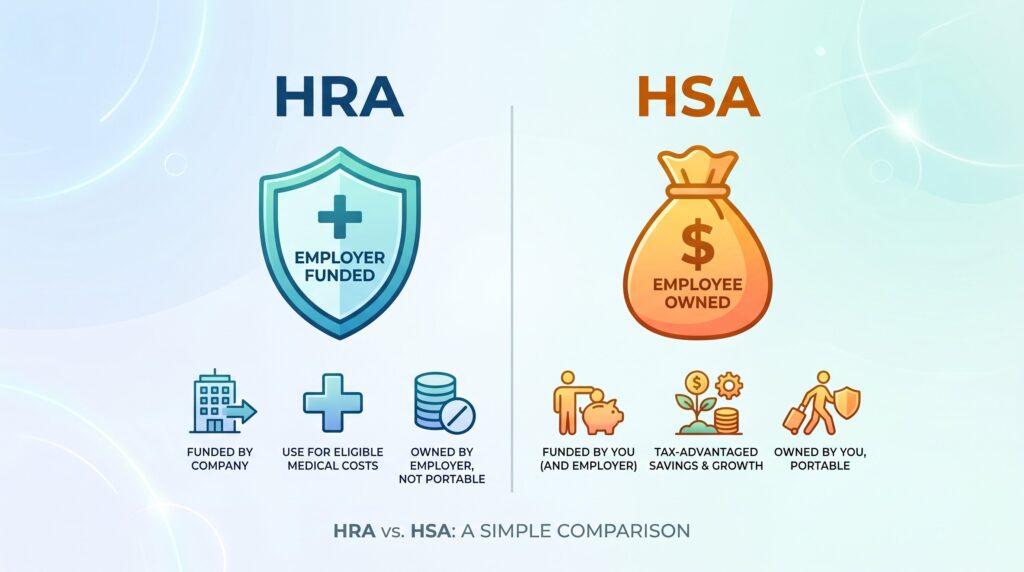
Healthcare benefits can feel like alphabet soup: HSA, HRA, FSA, HDHP, ICHRA, QSEHRA. The names sound similar, but the rules can lead to very different financial outcomes. If you’re comparing HSA vs HRA during 2026 open enrollment, the most important question isn’t which account sounds better. It’s which one fits your health costs, cash flow, tax strategy, and job situation.
A Health Savings Account and a health reimbursement arrangement can both help pay medical expenses, but they work in opposite ways. One is personally owned. The other is employer-controlled. One can grow like a long-term asset. The other can reduce today’s out-of-pocket costs without requiring you to contribute your own money.
HRA vs. HSA vs. FSA Benefits Comparison Chart
| Feature | HRA | HSA | FSA |
| Employee can contribute | ✗ | ✓ | ✓ |
| Employer can contribute | ✓ | ✓ | ✓ |
| Employee owns account | ✗ | ✓ | ✗ |
| Portable after leaving job | ✗ | ✓ | ✗ |
| Requires HDHP | Varies | ✓ | Usually no |
| Funds roll over | Varies | ✓ | Limited |
| Main purpose | Reimburse expenses | Save & pay healthcare | Pay predictable annual costs |
Note: HDHP = High Deductible Health Plan. Rules may vary by employer and plan type.
What is an HSA? The Personal Growth Engine

An HSA is a tax-advantaged account for people enrolled in an HSA-eligible high-deductible health plan. For 2026, the HSA contribution limits are $4,400 for self-only coverage and $8,750 for family coverage. People age 55 or older can add a $1,000 catch-up contribution.
The power of an HSA comes from its triple tax advantage. Contributions may reduce taxable income. Growth can be tax-free. Withdrawals for qualified medical expenses can also be tax-free. That combination makes an HSA more than a medical spending account. Used strategically, an HSA can become a “stealth IRA” for healthcare. You can pay current medical bills from the account, or you can invest the balance and save receipts for future reimbursement. If you’re healthy, have stable cash flow, and can handle the deductible risk, an HSA can turn routine healthcare planning into long-term wealth building.
What is an HRA? The Employer Reimbursement Model

So, what is an HRA? An HRA is a health reimbursement arrangement funded and owned by an employer. Some people search for health reimbursement account, but “arrangement” is more accurate because the funds aren’t held in a personal account you control.
Here’s how it works: you incur an eligible medical expense, submit documentation, and receive tax-free reimbursement if the claim qualifies. You aren’t investing the money, and you usually can’t take unused funds with you when you leave the company.
HRA rules 2026 vary by plan type. An ICHRA, or Individual Coverage HRA, can reimburse employees for individual health insurance premiums. A QSEHRA, or Qualified Small Employer HRA, is designed for small employers that don’t offer group health insurance. An integrated HRA works alongside a group plan to help with deductibles, copays, and coinsurance. That’s why ICHRA vs QSEHRA matters. One may fit employers that want broad flexibility across worker classes. The other may fit small businesses that want a simpler reimbursement structure.
2026 HSA vs. HRA Decision Simulator
To decide between HRA vs HSA, ask three questions.
- First, who carries the risk? With an HSA, you may benefit from tax savings and investment growth, but you’re usually paired with a higher-deductible plan. With an HRA, the employer absorbs part of the cost through reimbursement.
- Second, do you need portability? If you expect to change jobs, an HSA is stronger because the money remains yours. An HRA usually stays with the employer.
- Third, are you optimizing for today or tomorrow? If you need help paying current bills, an HRA may feel more valuable. If you want long-term tax-free savings, an HSA may be stronger.
Can You Have Both an HSA and an HRA?
Sometimes, but not always. A general-purpose HRA usually makes you ineligible to contribute to an HSA because it provides first-dollar medical coverage before you meet the HDHP deductible.
However, certain HRA designs may preserve HSA eligibility. A limited-purpose HRA can cover only dental and vision expenses. A post-deductible HRA can begin reimbursing after the HDHP deductible is met. A suspended HRA may allow employees to pause HRA reimbursements so they can contribute to an HSA. This is the most technical part of health savings account vs health reimbursement account planning, so employees should confirm the plan design before making payroll elections.
3 Strategic Reasons to Choose an HSA in 2026
First, an HSA offers investment potential. Unlike HRAs, HSA funds can often be invested and left to grow for years. Second, it’s portable. If you quit, retire, or switch careers, the balance remains yours. Third, it provides retirement flexibility. After age 65, non-medical withdrawals are allowed without the usual penalty, although they’re taxed as income. Medical withdrawals can still remain tax-free.
3 Strategic Reasons to Choose an HRA in 2026
First, some HRAs don’t require a high-deductible health plan. That can be helpful if you prefer traditional coverage. Second, an HRA can provide employer-paid premium support. ICHRAs, for example, may reimburse individual insurance premiums. Third, you don’t have to contribute your own paycheck. If cash flow is tight, employer-funded reimbursement can be more practical than saving into an HSA.
Conclusion
The best choice depends on your health needs, savings capacity, and employer plan rules. An HSA is often better for people who want ownership, portability, investment growth, and long-term tax strategy. An HRA is often better for people who want employer-funded help with current healthcare costs. Before open enrollment closes, review your plan documents carefully. The real difference between HSA and HRA isn’t just the name. It’s who owns the money, who controls the rules, and whether the benefit helps you most today, tomorrow, or both.
Related Articles
HSA vs. FSA: 2026 Key Differences & Which Is Better? (+ Chart)