


Estate planning is a vital part of securing your financial future and ensuring that your assets are distributed according to your wishes after your death. Two of the most common legal tools used for estate planning are wills and trusts. While both serve the purpose of outlining how your assets should be handled after your death, they operate differently and offer distinct benefits. Choosing the right one for you can be a challenge, as each comes with its own set of advantages and limitations.
In this guide, we’ll explore the key differences between a will and a trust, explain the benefits of each, and provide clear guidance on which one may be the best fit for your personal situation.
What is a Will?
A will is a legal document that expresses your wishes regarding the distribution of your assets after your death. This document typically designates an executor, the person responsible for ensuring that your estate is handled according to your instructions. Wills can cover a variety of issues, such as distributing property, naming guardians for minor children, and paying off debts.
However, one major disadvantage of a will is that it must go through the probate process. Probate is a legal procedure in which the court verifies the validity of the will and supervises the distribution of the estate. While probate is often necessary to ensure that the will is followed, it can be time-consuming, costly, and public. Your estate’s details become part of the public record during this process, which means that anyone can access information about your assets, debts, and beneficiaries.
Despite these drawbacks, a will remains a fundamental part of estate planning, especially for those with straightforward estates or those who have minor children. It provides clear guidance for asset distribution and offers a way to appoint a guardian for your children, something a trust can’t do.

What is a Trust?
A trust is a legal arrangement in which one party (the trustee) holds and manages assets for the benefit of another party (the beneficiary). Trusts can be used to distribute assets during your lifetime or after your death. Unlike a will, a trust isn’t required to go through probate, which makes it a valuable tool for individuals looking to avoid the lengthy and costly probate process. Additionally, trusts offer greater flexibility and control over how and when your assets are distributed.
There are several different types of trusts, each serving a specific purpose. A revocable trust, for example, can be altered or revoked during your lifetime, allowing you to retain control over your assets. In contrast, an irrevocable trust can’t be changed or dissolved once established, offering greater protection from creditors and potential estate tax benefits. Other specialized types of trusts include charitable trusts, which benefit a charity, and special needs trusts, which are designed to provide for a loved one with special needs without affecting their eligibility for government benefits.
Key Differences Between Wills and Trusts
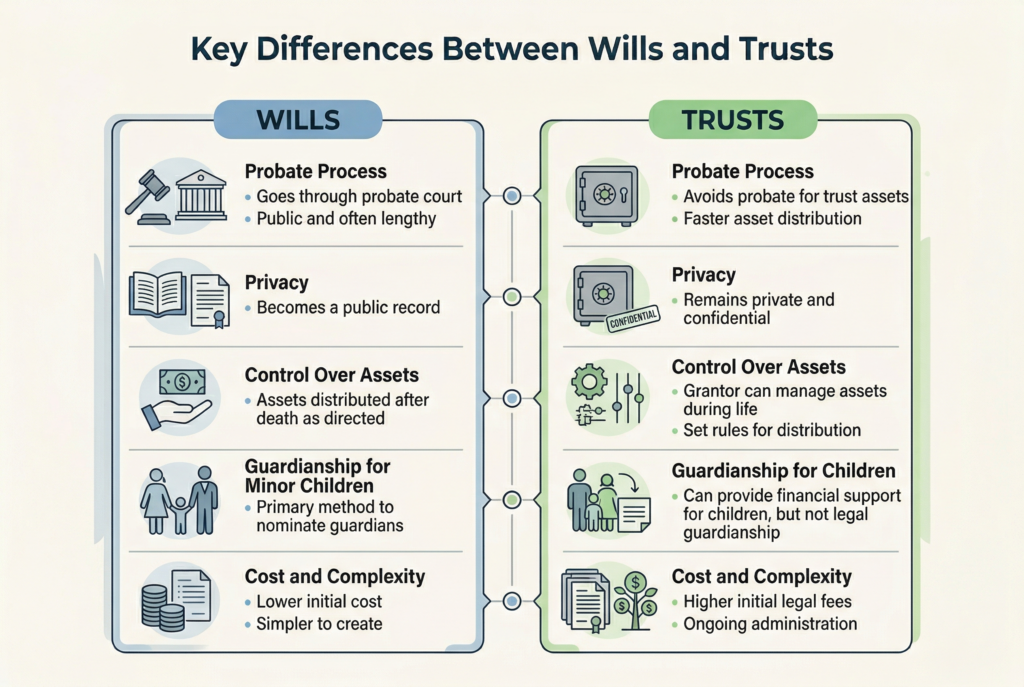
When deciding whether a will or trust is the best option for your estate plan, it’s essential to understand the primary differences between the two.
Probate Process
The most significant difference lies in the probate process. Wills must go through probate, which is often a lengthy process that can take several months or even years to complete. In contrast, assets held in a trust bypass probate, meaning that they can be distributed to beneficiaries much more quickly and privately. This is especially important for individuals who want to avoid the delays and costs associated with probate or wish to keep their estate details confidential.
Privacy
Another key difference is the privacy factor. Since a will goes through probate, it becomes a matter of public record. Anyone can access the details of the will, including information about your assets, debts, and who will receive what. On the other hand, a trust is private. Since a trust doesn’t go through probate, its terms and the distribution of assets remain confidential, protecting the privacy of your beneficiaries.
Control Over Assets
Control over your assets is another consideration. With a will, your beneficiaries will receive their inheritance outright, typically after probate has been completed. In contrast, a trust allows you to impose specific conditions on when and how your beneficiaries receive their inheritance. For example, you may choose to set up a trust that distributes assets to a child over several years or once they reach a certain age, ensuring that the money is managed responsibly.
Guardianship for Minor Children
A will is the only way to appoint a guardian for your minor children. If you have young children, this is an essential aspect of your estate planning. A trust doesn’t serve this purpose.
Cost and Complexity
Wills are generally easier and less expensive to create than trusts. Trusts, particularly irrevocable trusts, require more detailed planning and typically involve higher legal fees. However, the benefits of a trust, such as avoiding probate and providing long-term control, may justify the additional cost.
When Should You Use a Will?

A will is typically the best option for individuals with simple estates. If your assets are straightforward and you don’t need to make complicated distributions or avoid probate, a will may be sufficient. Additionally, if you have minor children, a will is crucial for appointing guardianship. This is something that a trust cannot accomplish, making a will necessary for anyone who wants to ensure that their children are cared for by a designated guardian.
Wills are also appropriate for those who are comfortable with the probate process or have relatively small estates. The probate process can be efficient in some cases, especially if the estate isn’t complex, and having a will ensures that your wishes are legally binding.
When Should You Use a Trust?
A trust is most beneficial when you want to avoid probate entirely or when you want greater control over how and when your assets are distributed. Trusts are especially useful for individuals with larger estates, particularly those who own property in multiple states or have business interests that need to be managed after their death.
Trusts are also essential for those seeking to reduce estate taxes. Certain types of trusts, like irrevocable trusts, can help reduce the value of your taxable estate, thus lowering the amount your beneficiaries will have to pay in estate taxes. Trusts can also offer protection from creditors, making them a powerful tool for asset protection.
Moreover, if you have special needs family members, a special needs trust can provide for their care without jeopardizing their eligibility for government benefits. Similarly, if you have philanthropic goals, a charitable trust allows you to support your favorite causes and can offer tax benefits as well.
Benefits of Combining a Will and a Trust
In some cases, the best estate plan involves using both a will and a trust. For example, a pour-over will can complement a trust by ensuring that any assets not already placed in the trust during your lifetime will be transferred into it upon your death. This combination allows you to benefit from the advantages of both documents: ensuring comprehensive asset distribution, avoiding probate, and protecting privacy.
Conclusion
Choosing between a will and a trust depends on your unique financial situation, goals, and family dynamics. A will is typically sufficient for those with simple estates, especially if you need to appoint a guardian for your children. On the other hand, a trust offers more control, privacy, and can help reduce estate taxes, making it a better choice for those with more complex estates or specific asset protection needs.
Regardless of which option you choose, it is essential to work with an experienced estate planning attorney to ensure your estate is structured according to your wishes. Estate planning is an ongoing process, and reviewing your will and/or trust periodically will ensure that it reflects any changes in your life or financial situation.
By understanding the key differences and benefits of wills and trusts, you can make informed decisions about your estate planning and protect your legacy for future generations.