
When financing a car, the general recommendation is to make a 20% down payment on a new car and a minimum 10% down payment on a used car. That rule isn’t perfect for every buyer, but it gives you a strong financial starting point before walking into a dealership.
In 2026, with many new cars still priced around 48,000 USD, a 20% down payment means roughly 9,600 USD upfront. For a used car around 25,000 USD, a 10% down payment means about 2,500 USD. That may feel like a lot, especially if you’re balancing rent, insurance, savings, and daily expenses. Still, a larger car down payment can lower your monthly payment, reduce total interest, improve loan approval odds, and protect you from negative equity.
You can buy with less. Some buyers put down 2,000 USD, 1,000 USD, or even nothing. But the less you put down, the more you borrow, and the more exposed you become if the car loses value faster than you repay the loan.
The Core Benchmark: How Much Should You Put Down on a Car?
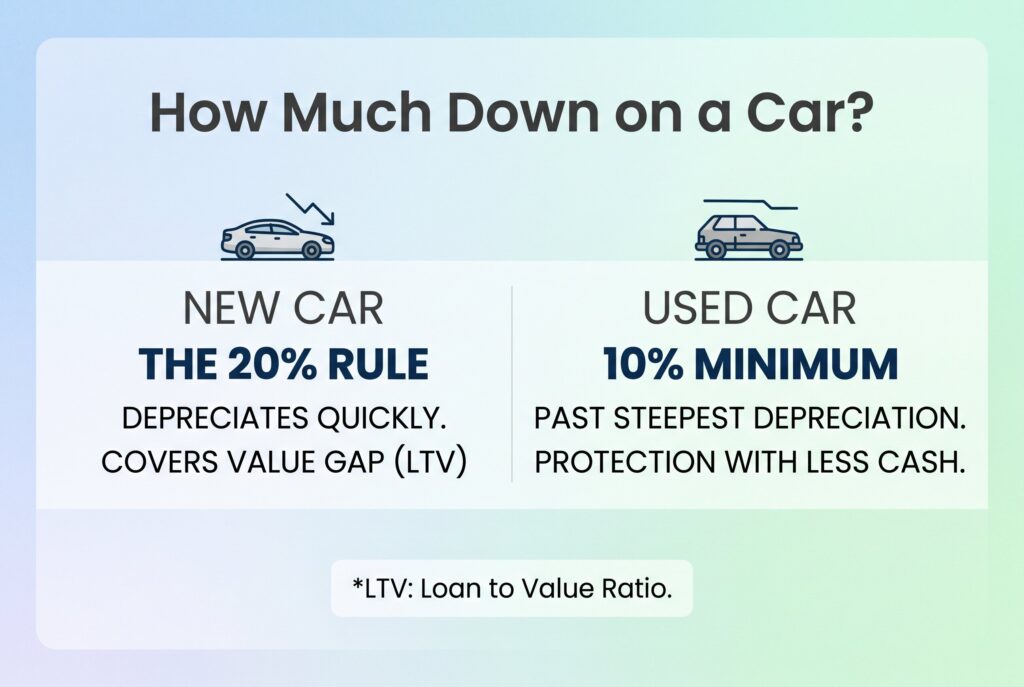
The classic 20% rule exists because new cars depreciate quickly. A new vehicle may lose a meaningful share of value during the first year, so a 20% down payment gives you a cushion between what the car is worth and what you owe. That cushion matters because lenders look closely at loan to value ratio, also called LTV. A lower LTV tells the lender you’re less risky.
Used cars are different. Since they have already passed the steepest early depreciation period, a 10% down payment is often a reasonable minimum. It still reduces the loan balance and gives you some protection without requiring as much cash as a new vehicle.
The Brutal Math: What If I Only Have 2,000 USD?
A limited budget doesn’t necessarily prevent you from buying a car. With a 2,000 USD down payment, you could put money toward a 25,000 USD used vehicle and finance the remaining balance through a loan. A 2,000 USD down payment is only 8%, which is below the ideal 10% target. But it’s still much better than zero down because it immediately lowers the amount financed. That 2,000 USD may also improve your approval odds. Lenders like seeing that you have some financial commitment in the vehicle. It can be especially important if your credit score isn’t strong, your income is new, or your credit history is limited.
The danger comes when buyers focus only on getting approved. A low down payment means a larger loan, more interest, and a higher monthly payment. If the loan term stretches to 72 or 84 months, the payment may look manageable, but you could stay upside down for years. That means you owe more than the car is worth. If 2,000 USD is all you have, use it wisely. Choose a cheaper vehicle, avoid unnecessary dealer add-ons, compare financing offers, and keep some cash aside for insurance, registration, and first month expenses.
3 Hidden Benefits of a Larger Down Payment
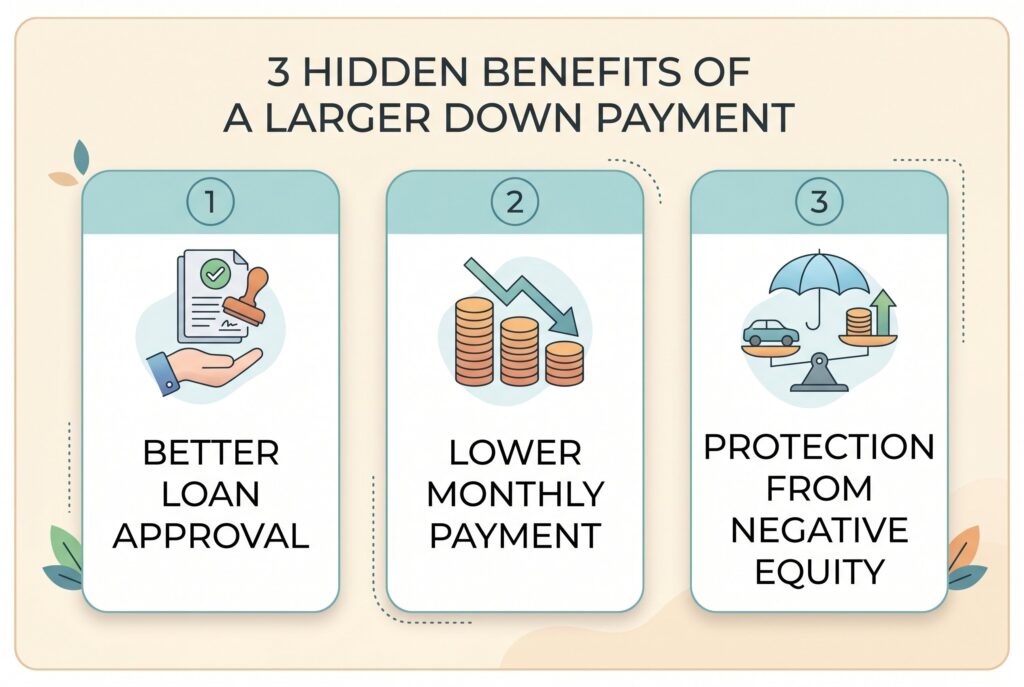
1. Better Loan Approval
A larger down payment on a car can make lenders more comfortable. If your credit score is average or damaged, cash upfront can offset part of that risk. It shows that you’re invested in the purchase and reduces the lender’s exposure if the loan goes bad.
2. Lower Monthly Payment
Every 1,000 USD you put down can reduce your monthly payment by roughly 18 to 20 USD on many common auto loan structures, depending on APR and term. That may not sound huge, but over five or six years, it adds breathing room to your budget. Lower payments also make it easier to handle insurance, gas, maintenance, and repairs.
3. Protection From Negative Equity
Negative equity is the hidden trap many buyers don’t see until they want to trade or sell. If you finance too much and the car drops in value, you may owe more than the vehicle is worth. A larger car down payment helps protect you from being upside down, especially during the first two years of ownership.
Average Down Payment on a Car
The average down payment on a car depends on whether you’re buying new or used, your credit profile, and the vehicle price. As a general benchmark, many buyers aim for about 20% down on a new car and at least 10% down on a used car. In real life, though, not everyone reaches that target. For a new car priced around 48,000 USD, a 20% down payment would be about 9,600 USD. For a used car priced around 25,000 USD, a 10% down payment would be about 2,500 USD. These numbers give you a useful starting point, but your ideal down payment should also depend on your monthly budget, loan term, APR, and how much cash you need to keep for emergencies.
Some buyers put down less than the recommended amount, especially when money is tight. A smaller down payment can still help you get into a vehicle, but it usually means borrowing more, paying more interest, and taking on a higher risk of negative equity. The better goal is to put down as much as you comfortably can without draining your savings.
Creative Ways to Fund Your Down Payment on a Car
Your dealership down payment doesn’t have to come only from your checking account. One of the strongest options is trade in equity. If your current car is worth 5,000 USD and you don’t owe anything on it, that value can usually be applied directly to your next purchase.
A tax refund car down payment can also be useful. Instead of spending the refund quickly, you can use it to reduce your loan balance, improve approval odds, and lower the monthly payment. This works best when you already have emergency savings and aren’t using every dollar at once.
Dealers may also accept several payment methods, including cashier’s check, money order, debit card, and sometimes a limited credit card amount. Always confirm before visiting the dealership because payment rules vary. Some dealers don’t accept large credit card payments because of processing fees.
Conclusion
The best answer to how much should I put down on a car isn’t one rigid number. The 20% new car and 10% used car rule is a strong target, but your real decision should balance cash flow, credit strength, vehicle price, APR, loan term, and emergency savings.
A higher down payment can save money and reduce risk, but an empty bank account is dangerous too. The smartest move is to buy less car than the lender says you can afford, put down as much as you comfortably can, and keep enough cash to stay secure after the keys are in your hand.