


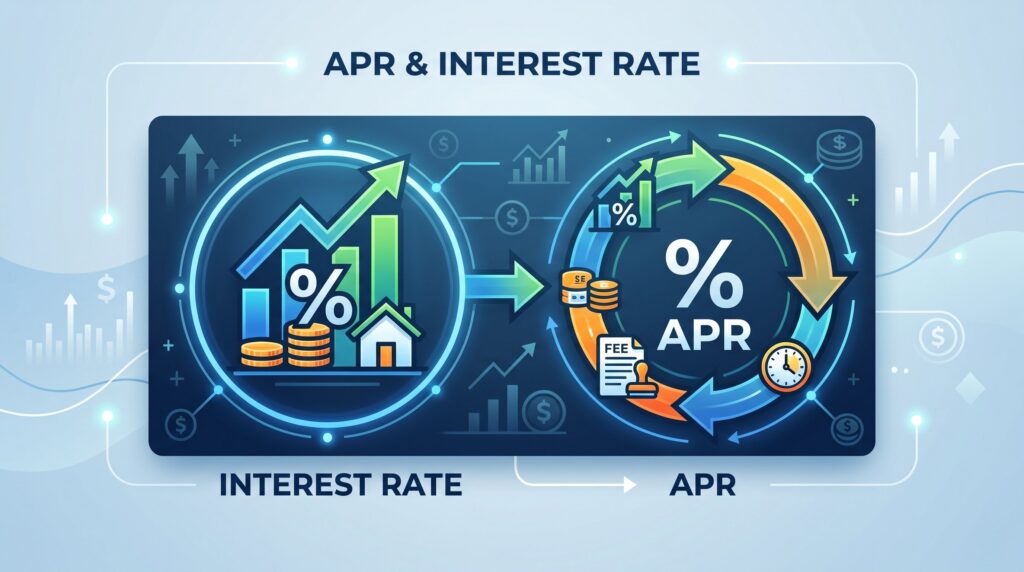
The difference between APR and interest rate can confuse almost any borrower, especially when loan disclosures are full of percentages, fees, closing costs, and fine print. A lender may advertise a low interest rate, but the loan may still be expensive once all required fees are included. This guide explains APR vs interest rate in plain English, so you can compare mortgage offers with more confidence and avoid paying more than you expected.
What Is An Interest Rate? The Base Cost

An interest rate is the percentage a lender charges you to borrow money. For a mortgage, it’s the number used to calculate your monthly principal and interest payment. If you’re trying to decide whether a home loan fits your monthly budget, the interest rate is the first number to check.
For example, a lower interest rate usually means a lower monthly payment, assuming the loan amount and term stay the same. That’s why borrowers often focus on rate shopping. However, the interest rate alone doesn’t show the full cost of borrowing. A loan with a lower interest rate may come with higher upfront fees. That’s where APR becomes important.
What Is APR? The True Cost Metric

APR stands for Annual Percentage Rate. It gives you a broader view of what a loan really costs over a year. In a mortgage, APR usually includes the interest rate plus certain lender fees.
How APR is calculated depends on the loan terms and which costs are included. Common APR costs may include origination fees, discount mortgage points, underwriting fees, and mortgage insurance. These charges can make the APR higher than the advertised rate.
Some costs usually aren’t included in APR, such as title insurance, appraisal fees, and credit report fees. Because rules can vary by loan type, always review the official Loan Estimate carefully before deciding. Annual percentage rate vs interest rate is really a question of monthly payment versus total borrowing cost. The interest rate helps you budget. APR helps you compare the fairness of the deal.
Interactive Tool: APR vs. Interest Rate Calculator
An APR vs interest rate calculator can show how upfront fees change the real cost of a loan. Imagine two lenders offer the same loan amount. One has a slightly lower interest rate but charges thousands more in points and fees. The other has a higher rate but lower upfront costs.
At first glance, the lower rate may look better. But after calculating APR, the second offer may actually be cheaper depending on how long you keep the loan. This is why borrowers shouldn’t compare mortgage offers using the interest rate alone. Fees can distort the true cost. A calculator makes that difference easier to see before you commit.
Compare Offers: APR vs Interest Rate
A low interest rate may look better at first glance, but upfront fees can distort the true cost. Compare two loan offers below to see which one is actually cheaper over time.
The Decision Framework: Short Term vs. Long Term Borrowing
The best loan choice depends on how long you plan to keep it. A low interest rate isn’t always the smartest deal if it requires expensive upfront costs.
Scenario A: Selling in 5 Years
If you expect to sell the home or refinance within a few years, paying a large amount in mortgage points may not make sense. For example, if you pay $10,000 upfront to reduce your rate, but you only save $150 per month, it would take more than five years to break even. If you move before then, you may lose money. In this situation, a loan with fewer upfront fees and a slightly higher rate may be better. Your monthly payment may be higher, but your total cost during the short ownership period could be lower.
Scenario B: The 30 Year Forever Home
If you plan to stay in the home for decades, paying upfront fees to reduce your rate can make more sense. Over 30 years, a lower rate may save far more than the original cost of points. For long term borrowers, the lowest possible APR often matters more. That’s because APR reflects the total cost spread across the full loan term. If you’re confident you won’t move or refinance soon, a lower APR can be a strong sign of better long term value.
How To Read Your Loan Estimate Document

Your Loan Estimate is one of the most important documents in the mortgage process. It helps you compare mortgage offers apples to apples. On Page 1, look for the interest rate and projected monthly payment. This tells you whether the loan fits your budget. On Page 3, look for the Comparisons section. This is where you’ll find APR and Total Interest Percentage, often called TIP. APR shows the annual cost including certain fees. TIP shows how much interest you’ll pay over the life of the loan as a percentage of the loan amount.
When comparing lenders, don’t only look at the payment. Compare the interest rate, APR, closing costs, points, and cash needed to close. A lender with a low monthly payment may still have expensive upfront fees.
ARMs vs. Fixed Rates: The APR Trap
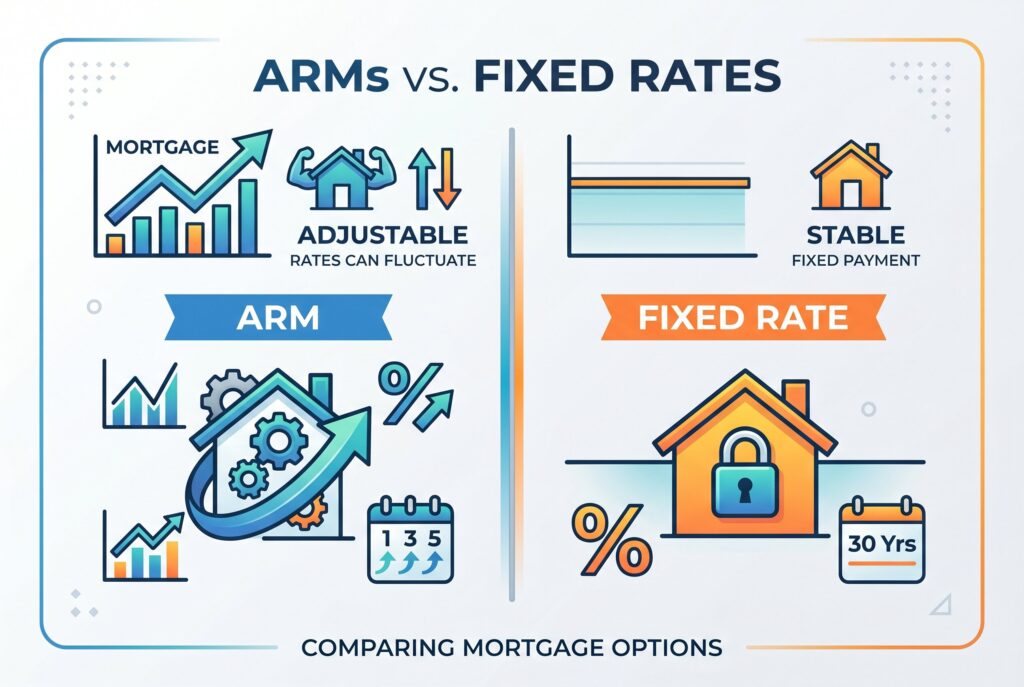
Adjustable Rate Mortgages, or ARMs, can make APR comparisons tricky. A 30 year fixed mortgage has one rate structure for the life of the loan. A 5/1 ARM may offer a lower starting rate for five years, then adjust later. The danger is that the ARM’s APR depends on assumptions about future rate changes. Those assumptions may not match what actually happens. If rates rise after the fixed period ends, your payment can increase.
That’s why comparing the APR of a fixed mortgage against an ARM can be misleading. The ARM may look cheaper at first, but it carries uncertainty. If you’re considering an ARM, understand the adjustment caps, index, margin, and maximum possible payment before signing.
Conclusion
The difference between APR and interest rate comes down to purpose. Use the interest rate to understand your monthly payment. Use APR to understand the broader cost of the loan. When shopping for a mortgage, don’t let a low advertised rate distract you from fees, closing costs, or mortgage points. The best offer isn’t always the one with the lowest interest rate. It’s the one that fits your budget today and makes sense for how long you plan to keep the loan. A simple rule can help: budget by interest rate, but shop by APR.

