

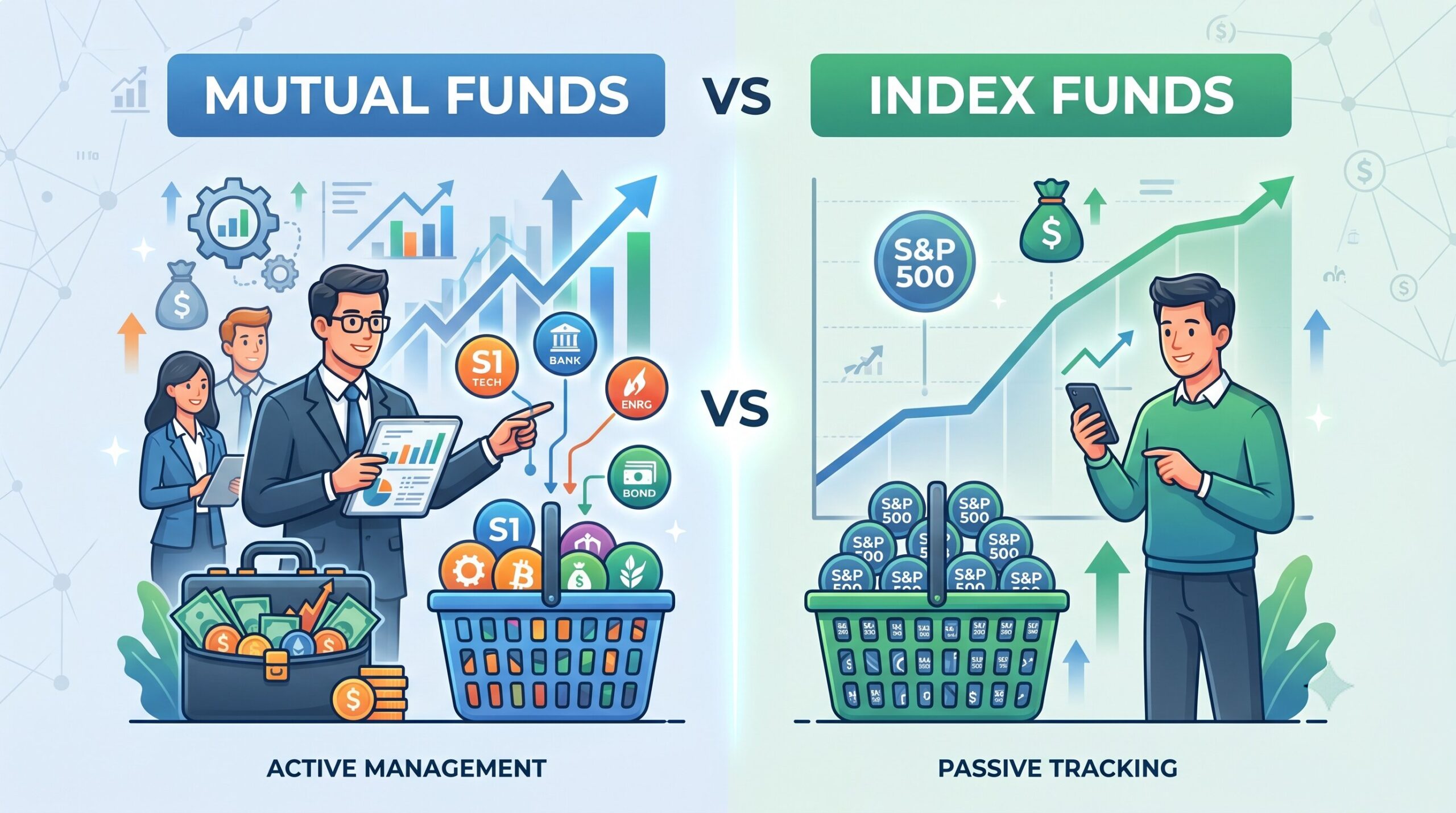
When comparing mutual funds vs index funds, many beginners assume they are two completely separate investment products. The truth is more subtle: most index funds are actually mutual funds, but not all mutual funds are index funds.
The real difference isn’t always the “fund wrapper.” It is an investment strategy. Traditional mutual funds are often actively managed by portfolio managers who try to beat the market. Index funds are usually passively managed and designed to track a benchmark, such as the S&P 500. For many long-term investors in 2026, low-cost index funds remain the better default choice because they are cheaper, more tax-efficient, and easier to manage. But active mutual funds can still make sense in certain specialized situations.
At a Glance: Mutual Fund vs Index Fund
Here is the quick comparison:
| Feature | Traditional Mutual Fund | Index Fund |
| Investment objective | Beat the market | Match the market |
| Management style | Active portfolio managers | Passive rules-based tracking |
| Typical expense ratio | Around 0.50%–1.00% | Around 0.02%–0.20% |
| Trading activity | Higher | Lower |
| Tax efficiency | Often lower | Often higher |
| Research needed | More | Less |
| Best for | Specialized strategies | Long-term “set it and forget it” investing |
The most important thing to remember is that “mutual fund” describes a vehicle, while “index fund” describes a strategy. A fund can be both a mutual fund and an index fund at the same time.
How is a Mutual Fund Different Than an Index Fund?
How is a mutual fund different than an index fund? The main difference is active vs passive management. An actively managed mutual fund uses human managers and analysts to choose investments. Their goal is to outperform a benchmark. For example, an active U.S. stock fund may try to beat the S&P 500 by selecting companies the manager believes are undervalued. An index fund doesn’t try to beat the market. It tries to copy the market. If an S&P 500 index fund tracks the S&P 500, it holds the companies in that index and adjusts as the index changes. That sounds less exciting, but boring can be powerful. Index funds remove much of the guesswork, reduce costs, and avoid depending on one manager’s decisions.
1. Expense Ratios: Small Fees Become Big Money
Expense ratio is one of the biggest differences in the mutual funds vs index funds debate. It is the annual fee charged by the fund, expressed as a percentage of your investment. Imagine you invest $10,000. If an index fund charges 0.05%, your annual cost is about $5. If an active mutual fund charges 0.64%, your annual cost is about $64. That may not sound dramatic in one year, but over 20 or 30 years, the gap can become thousands of dollars.
Fees matter because they come out whether the fund performs well or poorly. An active fund must beat the index by enough to cover its higher cost before you actually come out ahead. That is why low-cost index funds have become so popular with retirement savers, IRA investors, and long-term brokerage account holders.
2. Long-Term Performance: Beating the Market is Hard
Active funds sound attractive because the promise is simple: a skilled manager may find better stocks than the index. But in practice, beating the market consistently is difficult. Many active managers may outperform for a year or two, but staying ahead for 10 or 15 years is much harder. After fees, trading costs, and tax drag, many active funds underperform their benchmarks over long periods.
That doesn’t mean every active mutual fund is bad. Some managers do add value, especially in less efficient markets or specialized sectors. But choosing those winners in advance is difficult. Index funds take a different approach. Instead of trying to find the winning manager, they accept market returns at a very low cost. For many investors, that tradeoff is enough.
3. Tax Drag: Why Index Funds Can Be More Efficient
Tax efficiency is another major factor. Active mutual funds often buy and sell securities more frequently. When those trades create gains, investors in taxable brokerage accounts may receive capital gains distributions. That can create a tax bill even if you didn’t sell your shares. Index funds usually trade less because they simply track a benchmark. Lower turnover may mean fewer taxable distributions. This makes index funds especially attractive in taxable accounts. Inside tax-advantaged accounts, such as a 401(k), IRA, or Roth IRA, tax drag matters less because gains are sheltered. But in a regular brokerage account, tax efficiency can meaningfully affect your after-tax return.
Interactive Tool: The Investment Fee Calculator
Investment Fee Calculator
Use this calculator to see how investment fees affect wealth over time. Enter a starting investment, monthly contribution, expected return, expense ratios, and timeline. Then compare a low-cost index fund with a higher-cost active mutual fund.
| Fund Type | Net Annual Return After Fees | Ending Value | Growth Above Contributions |
|---|---|---|---|
| Low-Cost Index Fund | 0.00% | $0.00 | $0.00 |
| Higher-Cost Active Fund | 0.00% | $0.00 | $0.00 |
Net Annual Return = Expected Annual Return − Expense Ratio
Future Value of Starting Investment = Starting Investment × (1 + Net Return)Years
Future Value of Monthly Contributions = Monthly Contribution × [((1 + Monthly Net Return)Months − 1) ÷ Monthly Net Return]
Wealth Lost to Higher Fees = Low-Cost Fund Ending Value − High-Cost Fund Ending Value
Note: This calculator assumes both funds earn the same market return before fees and uses a simplified constant-return model. It does not include taxes, trading costs, advisor fees, loads, market volatility, sequence risk, or tracking differences.
A strong investment fee calculator should show how fees affect wealth over time. To use one, enter:
- Starting investment
- Monthly contribution
- Expected return
- Expense ratio
- Investment timeline
Then compare a low-cost index fund with a higher-cost active mutual fund. For example, assume two investors each start with $25,000 and add $500 per month for 30 years. If both portfolios earn the same market return before fees, the lower-fee option may end with significantly more money simply because less return was lost to expenses. This is the hidden power of index funds: they don’t need to be brilliant. They just need to be cheap, diversified, and consistent.
The Confusion Cleared: ETF vs Mutual Fund vs Index Fund

The phrase ETF vs mutual fund vs index fund can be confusing because it mixes strategy and structure. Index fund is a strategy. It tracks an index. Mutual fund is a vehicle. It is bought or sold once per day after the market closes. ETF is also a vehicle. It trades throughout the day like a stock. That means you can buy an S&P 500 index fund as a mutual fund or as an ETF. Both may follow the same index, but the trading experience differs. Mutual funds can be convenient for automatic investing, especially in retirement accounts. ETFs can be useful for intraday trading, lower minimums, and taxable-account flexibility. The right choice depends on how you invest, not just what you invest in.
When Active Mutual Funds May Still Make Sense

Index funds are a strong default, but active mutual funds aren’t useless. They may make sense if you want exposure to a niche market, a specific strategy, or a manager with a disciplined process. For example, some investors use active funds for small-cap stocks, international markets, bonds, or alternative strategies. Others prefer professional management because they don’t want to build or rebalance a portfolio alone. The key is being honest about cost. If you choose an active mutual fund, ask: What is the expense ratio? Has the manager outperformed after fees? Does the strategy duplicate what I already own? Is the fund tax-efficient enough for my account type?
Conclusion
For most individual investors, low-cost index funds are the better long-term starting point. They are simple, diversified, tax-efficient, and inexpensive. They also fit a “set it and forget it” strategy, which is exactly what many retirement investors need.
Active mutual funds may still have a role if you understand the fees, risks, and strategy. But they should earn their place in your portfolio. In 2026, the best answer to mutual fund vs index fund isn’t about chasing complexity. It is about choosing the structure that helps you stay invested, keep costs low, and build wealth steadily over time.
