



The best way to invest 10K depends on your timeline, risk tolerance, debt situation, and financial goals. There isn’t one perfect answer for everyone. A person saving for a house in two years shouldn’t invest the same way as someone building retirement wealth over 30 years.
Before choosing any investing strategies, handle the basics first. Pay off high-interest debt, especially credit cards, because a 20% APR balance can destroy wealth faster than most investments can grow it. Then build an emergency fund with three to six months of essential expenses. Once your foundation is stable, $10,000 can become a serious launchpad. It can protect your short-term plans, build long-term wealth, create passive income, or help you buy skills that raise your future income.
Interactive Tool: The $10k Compound Growth Visualizer
$10k Compound Growth Visualizer
Use this visualizer to see how $10,000 can grow over time at different annual return rates. Change the starting amount, timeline, or return scenarios to compare how compounding turns gains into future gains.
| Scenario | Ending Value | Total Contributions | Estimated Growth |
|---|---|---|---|
| 4.00% | $0.00 | $0.00 | $0.00 |
| 7.00% | $0.00 | $0.00 | $0.00 |
| 8.00% | $0.00 | $0.00 | $0.00 |
Future Value of Starting Amount = Starting Amount × (1 + Annual Return)Years
Future Value of Monthly Contributions = Monthly Contribution × [((1 + Monthly Return)Months − 1) ÷ Monthly Return]
Total Ending Value = Future Value of Starting Amount + Future Value of Monthly Contributions
Note: This calculator is for education only. It assumes a constant annual return and does not include taxes, fees, market volatility, inflation, investment risk, or timing differences. Actual investment results can vary.
A compound growth visualizer should show how $10,000 can grow over time at different rates of return. For example, $10,000 earning 4% annually grows slowly but safely. At 7% or 8%, the long-term difference becomes much larger because your gains begin earning gains. This is how to make your money work for you. The goal isn’t only to save money. It’s to place money where time, interest, dividends, or business growth can multiply it.
Why is Investing a More Powerful Tool to Build Long-Term Wealth Than Saving?
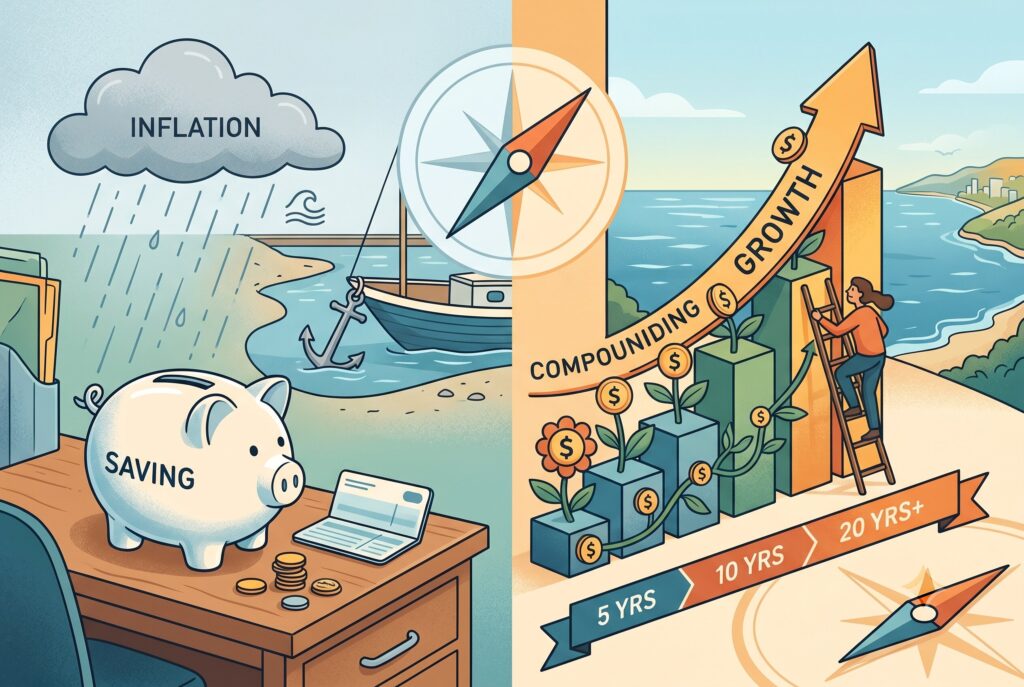
Saving protects your money. Investing grows it. Both matter, but they serve different jobs. Savings accounts are useful for short-term goals because the money stays stable and accessible. But inflation slowly reduces purchasing power. If your cash earns less than prices rise, you may technically have the same dollars while being able to buy less.
Investing is more powerful for long-term wealth because it gives your money exposure to compound growth. Stocks, index funds, retirement accounts, REITs, and businesses can rise over time. They can also fall, which is why your timeline matters. The longer your money can stay invested, the more time it has to recover from downturns and benefit from growth.
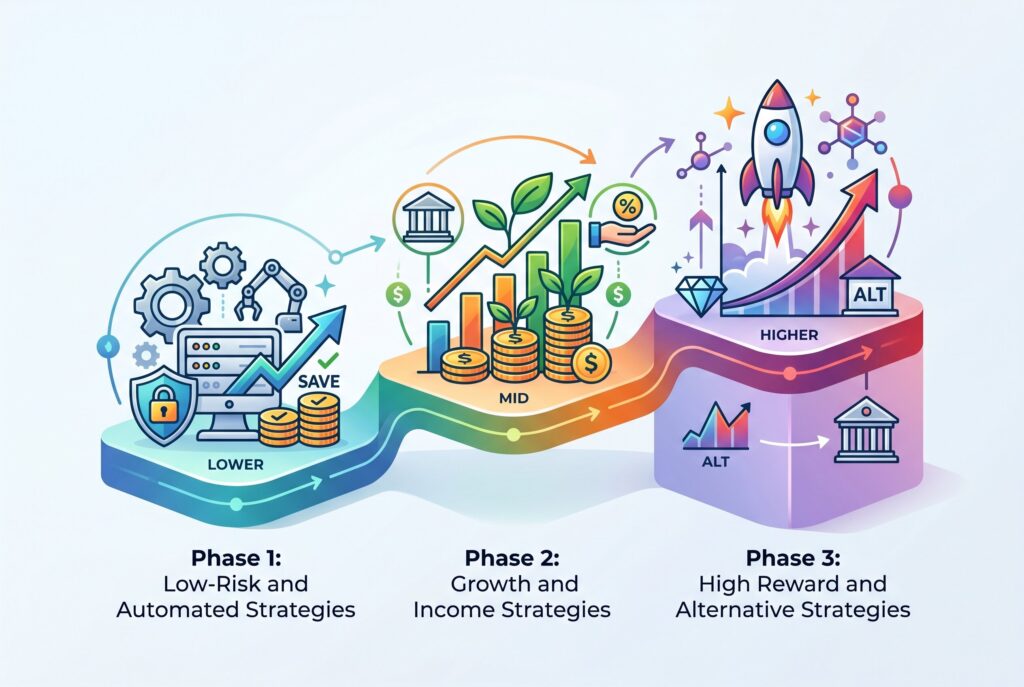
Phase 1: Low-Risk and Automated Strategies
1. High-Yield Savings Accounts and CD Ladders
If you need the money within one to three years, high-yield savings accounts and CD ladders may be among the best short term investments. A high-yield savings account keeps your money liquid, while a CD ladder lets you lock different portions of cash into staggered maturity dates. For example, you might split $10,000 into several CDs maturing at 3, 6, 9, and 12 months. That gives you better structure than leaving everything idle while still preserving access over time. This isn’t exciting investing, but it’s smart cash parking.
2. Set It and Forget It: Robo-Advisors
Robo-advisors are ideal if you want investing to feel automatic. You answer questions about your age, goal, timeline, and risk tolerance. Then the platform builds a diversified portfolio, usually using low-cost ETFs. This works well for beginners who don’t want to pick stocks or rebalance manually. With $10,000, a robo-advisor can spread your money across U.S. stocks, international stocks, bonds, and sometimes cash. The benefit is discipline. The downside is less control compared with managing your own portfolio.
3. The Ultimate Foundation: S&P 500 Index Funds
For long-term investors, an S&P 500 index fund is one of the simplest investing strategies. It gives you exposure to 500 large U.S. companies in one purchase. Instead of trying to guess the next winning stock, you own a broad slice of the market. This is a strong choice if your time horizon is at least five years, and ideally longer. The market will rise and fall, so this isn’t a safe parking place for next year’s house down payment. But for long-term wealth building, low-cost index funds are hard to beat.
Phase 2: Growth and Income Strategies
4. Maxing Out Your Roth IRA
A Roth IRA can be a powerful place to invest part of your $10,000 because qualified withdrawals in retirement can be tax-free. You contribute after-tax dollars, invest the money, and let it grow for decades. If you qualify based on income, consider funding a Roth IRA before using a regular brokerage account. Inside the account, you can buy index funds, ETFs, mutual funds, or other investments. The real value isn’t only the investment itself. It’s the tax shelter around it.
5. Dividend Growth Investing
Dividend growth investing focuses on companies that regularly pay and raise dividends. If you reinvest those dividends through a DRIP, your shares can compound over time. This can help investors who want income and growth. But don’t chase the highest yield blindly. A very high dividend can be a warning sign if the company can’t sustain it. Look for strong cash flow, reasonable payout ratios, and a history of reliable payments.
6. Fractional Real Estate: REITs and Crowdfunding
You don’t need to buy an entire rental property to invest in real estate. REITs, or real estate investment trusts, let you buy shares in companies that own income-producing properties. Some real estate crowdfunding platforms also allow smaller investors to participate in private real estate deals. This can create income and diversification, but it isn’t risk-free. REITs can fall like stocks, and crowdfunding deals may be less liquid. Use this strategy only for money you can leave invested for several years.
Phase 3: High Reward and Alternative Strategies
7. Targeted Individual Stock Picks
If you understand a company deeply, you may choose to invest a small portion of your $10,000 into individual stocks. This can create higher upside, but also higher risk. A balanced approach might put most of the money into diversified funds and reserve a smaller amount for individual companies. That way, one bad pick doesn’t ruin the entire plan. Individual stock investing requires research, patience, and emotional control.
8. Peer-to-Peer Lending and Private Credit
Peer-to-peer lending and private credit allow investors to lend money and earn interest. In theory, this can generate higher income than traditional savings. In practice, the extra yield comes with extra risk. Borrowers may default, platforms may have limited liquidity, and your money may be locked up longer than expected. This strategy isn’t ideal for emergency funds. It’s better suited for investors who understand credit risk and can diversify across many loans.
9. Invest in Yourself
Sometimes the highest-return investment isn’t a stock, fund, or real estate deal. It’s your own earning power. You might use $10,000 to earn a professional certification, learn coding, start a side hustle, build a website, buy equipment, improve sales skills, or launch a small service business. If that skill raises your income by $10,000 per year, the return can beat almost any traditional investment. The key is execution. Education is only valuable if it leads to better skills, higher income, or a real business outcome.
Conclusion
Which two habits are the most important for building wealth and becoming a millionaire? The answer is usually simple: live below your means and invest consistently. A $10,000 milestone matters because it proves you can save. Now the next step is making that money productive. If your goal is short term, choose safety. If your goal is long term, choose diversified growth. If your goal is income, consider dividends, REITs, or fixed income. If your goal is transformation, invest in skills that increase your earning power. The best way to invest 10k isn’t the flashiest strategy. It’s the strategy you understand, can stick with, and can repeat over time.

