



Can I retire at 60? Yes, it’s possible, but age 60 is still early retirement. You may be done working, but the financial system isn’t fully ready for you yet. Medicare usually doesn’t begin until 65, and the earliest Social Security benefit generally starts at 62. That creates a gap you must fund on your own.
The real question isn’t only how much money do I need to retire at 60. The better question is: how much will I spend, where will my income come from, and how long does my retirement portfolio need to last? For many households, retirement at 60 may require anywhere from $1.5 million to $3 million or more, depending on lifestyle, debt, healthcare, taxes, housing, and bridge income. A couple spending $80,000 a year may need a very different plan than someone spending $150,000 a year.
The Bridge Problem: Surviving Before Medicare & Social Security

The biggest challenge when you retire at 60 is the bridge period. You are too young for Medicare at 65 and may still be two years away from Social Security at 62. If you delay Social Security for a higher monthly benefit, the bridge lasts even longer. Healthcare before Medicare can be expensive. You may need COBRA, a public health insurance marketplace plan, private insurance, retiree coverage from a former employer, or coverage through a spouse’s job. This cost can change your retirement spending dramatically.
Bridge income can help. This might include part-time consulting, rental income, dividends, taxable brokerage account withdrawals, cash reserves, or a small business. Even $30,000 to $50,000 a year in bridge income can reduce the pressure on your portfolio during the most fragile early years of retirement. That matters because the first decade after retirement is critical. If markets fall while you are withdrawing heavily, your portfolio may struggle to recover.
The 4% Rule Retirement Calculator
A simple way to estimate how much to retire at 60 is the 4% rule. The formula is:
Estimated portfolio target = Annual spending × 25
If you need $80,000 a year from your retirement portfolio, you may need about $2 million. If you need $120,000 a year, the target rises to about $3 million. If you need $160,000 a year, you may need $4 million. But this is only a starting point. The 4% rule was built as a historical rule of thumb, not a personal guarantee. Early retirement at 60 may last 30 to 40 years, which creates longevity risk, inflation risk, investment risk, and healthcare risk. A stronger plan uses flexible withdrawals, cash reserves, Social Security timing, tax planning, and ideally a Monte Carlo simulation to test different market outcomes.
Is 60 the Best Age to Retire? Pros & Cons
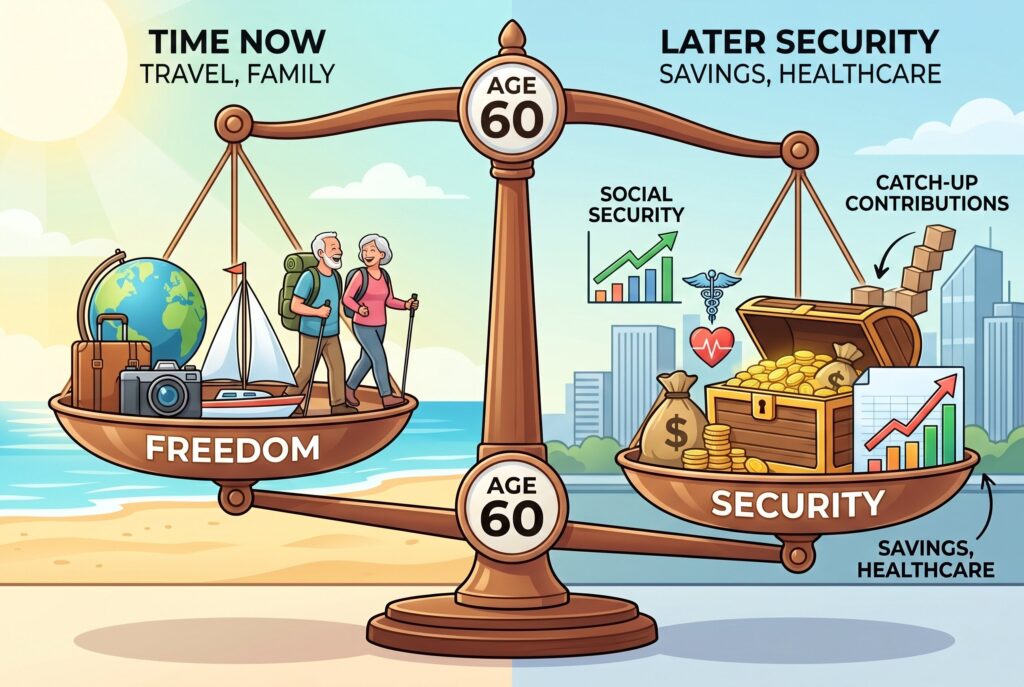
Is 60 the best age to retire? For some people, yes. For others, waiting a few more years can dramatically improve financial security. The biggest advantage of retiring at 60 is time. You may still have strong health, energy, and freedom to travel, spend time with family, start new projects, or simply step away from career stress. If you have enough assets, retiring at 60 can give you some of your best years back.
The drawbacks can be substantial. Retiring at 60 means giving up some of your highest-earning years, missing out on additional retirement contributions, and potentially covering healthcare costs before Medicare begins. Claiming Social Security early can also reduce your lifetime benefits. Ultimately, retiring at 60 is a tradeoff between enjoying more freedom now and maintaining greater financial security later.
3 Actionable Steps to Secure Your 60s
Pay Down High-Interest Debt
One of the most effective ways to strengthen your retirement plan is to eliminate high-interest debt before leaving the workforce. Credit card balances, personal loans, and high-rate auto loans can consume a significant portion of your monthly budget, reducing the flexibility you need once regular employment income stops. Every dollar spent on interest is money that can’t be used for living expenses, travel, healthcare, or investment growth. Entering retirement with little or no high-interest debt can lower financial stress and make your savings last longer.
Consider Downsizing
Housing costs often represent one of the largest expenses in retirement, which is why downsizing can have a major impact on long-term financial security. Moving to a smaller home, relocating to a lower-cost area, or choosing a state with lower taxes can significantly reduce monthly expenses. In some cases, selling a larger property can also unlock substantial home equity that can be added to retirement savings. For many early retirees, housing decisions create some of the biggest opportunities to improve cash flow without sacrificing quality of life.
Build a Tax-Efficient Withdrawal Strategy
How you withdraw money in retirement can be just as important as how much you have saved. A thoughtful withdrawal strategy can help reduce taxes and extend the life of your portfolio. Many retirees draw from taxable accounts first, followed by tax-deferred accounts such as traditional IRAs or 401(k)s, while preserving Roth accounts for later years. Additionally, lower-income years between retirement and Social Security eligibility may provide opportunities for Roth conversions at favorable tax rates. Proper planning can help minimize future tax burdens and increase after-tax retirement income.
Review Your Investment Allocation
Retiring at 60 doesn’t mean your portfolio should stop growing. Because retirement could last 25 to 35 years or more, maintaining some exposure to growth assets remains important. At the same time, taking excessive risk can expose retirees to significant losses during market downturns. A well-designed retirement portfolio should balance growth, stability, and income generation. Diversification across stocks, bonds, cash reserves, and other assets can help protect against volatility while still providing enough growth to keep pace with inflation over the long term.
Conclusion
Can I retire at 60? You can if your spending, healthcare plan, bridge income, and retirement portfolio all work together. The number alone isn’t enough. Retiring at 60 is built over decades. If you are younger and asking how much should i have in my 401(k) at 30, the answer matters because early saving shapes your future options. Your average net worth by age is only a benchmark, but your future net worth is the real story.
Retirement shouldn’t be a leap into uncertainty. It should be a planned transition from earning income to creating income. Track your assets, reduce debt, test your withdrawal plan, and make sure your bridge years are covered before you walk away.

